Nyungwe Forest National Park is one of the oldest and most biologically diverse rainforests in Africa — a vast, mist-shrouded canopy blanketing the mountains of south-western Rwanda that shelters chimpanzees, an astonishing 13 primate species, and some of the largest troops of colobus monkeys ever recorded on the continent. Walking its trails feels like stepping into a primordial world untouched by time.
Covering 1,019 square kilometres of montane rainforest along the Congo-Nile Divide at altitudes between 1,600 and 2,950 metres, Nyungwe is the largest remaining block of montane forest in East or Central Africa. Estimated to be millions of years old, the forest survived the Ice Ages that destroyed most of Africa's highland forests, preserving an extraordinary concentration of endemic species. Over 500 chimpanzees live within its borders, alongside 12 other primate species — including the Rwenzori colobus, which forms troops of up to 400 individuals, the largest arboreal primate aggregations on earth. More than 310 bird species have been recorded, including 27 Albertine Rift endemics found in no other habitat. The forest supports over 1,000 plant species, 200 orchid varieties, 120 butterfly species and 32 amphibian species. Its suspended canopy walkway — the first of its kind in East Africa — offers a perspective on the forest that is available nowhere else in Rwanda.
Hover over a month to discover what awaits


Nyungwe is one of the finest chimpanzee tracking destinations in Africa. Over 500 chimpanzees live within the forest, with several habituated communities in the Cyamudongo and Uwinka sectors. Tracking through the ancient canopy — listening for the chimps' pant-hoot calls echoing through the trees, then finding them feeding, grooming and playing in the dappled light — is a deeply immersive primate encounter and the perfect complement to the gorilla experience in Volcanoes.
The Rwenzori colobus troops of Nyungwe are one of the great primate spectacles on earth. Troops of up to 400 individuals — the largest arboreal primate aggregations ever recorded — move through the canopy in waves of black and white, leaping between branches with their long tails streaming behind them. Encountering a super-troop in motion is an unforgettable sight, and Nyungwe is the only place in Africa where aggregations of this scale can be reliably observed.
The canopy walkway is Nyungwe's signature experience — a 200-metre suspended bridge hanging 70 metres above the forest floor, offering a bird's-eye perspective on the rainforest canopy that is available nowhere else in Rwanda. Walking across the swaying bridge as mist rises from the valley below, with primates calling and hornbills gliding at eye level, is a thrilling sensory experience that redefines how visitors understand and connect with the forest.
With 13 primate species, Nyungwe harbours the highest primate diversity of any single forest in East Africa. Beyond chimpanzees and colobus, the forest supports L'Hoest's monkeys, grey-cheeked mangabeys, red-tailed monkeys, blue monkeys, olive baboons and the rare owl-faced monkey — one of Africa's most elusive primates. A morning walk through Nyungwe may yield sightings of four or five primate species without effort, each occupying a different layer of the forest.
Nyungwe is one of the most important birding destinations in the Albertine Rift, with over 310 species recorded — including 27 Albertine Rift endemics found in no other habitat on earth. The Rwenzori turaco, great blue turaco, Grauer's broadbill, red-collared babbler and the handsome francolin are among the highlights. Guided birding walks through the understorey and along the forest edge consistently deliver multi-species mornings that draw serious birders from across the world.
The Isumo waterfall trail is one of the most beautiful forest walks in Rwanda — a gentle two-hour hike through towering trees, fern-draped ravines and patches of bamboo to a stunning waterfall that cascades into a forested gorge. Along the way, L'Hoest's monkeys feed in the understorey, colobus troops swing overhead and the forest floor is carpeted with mosses, orchids and fungi. It is a walk that captures the full magic of Nyungwe beyond the primates.
Chimpanzee tracking and forest walks in Nyungwe operate year-round — the canopy walkway, the waterfall trail and all primate activities run every day regardless of weather. However, the dry seasons offer the most comfortable conditions and the best forest visibility.
The longer dry season from June through September is the most popular period. Trails are firm, the understorey is more open and fruiting trees concentrate chimpanzee communities in predictable areas. July and August are peak months. The shorter dry spell from December through February is equally excellent, with slightly fewer visitors.
The wet months of March to May and October to November bring the forest to its most intense, primordial life — orchids bloom, fungi carpet the forest floor, and the canopy drips with ferns and mosses. Birding and butterfly diversity peak during the rains. Trails are muddier but perfectly manageable with proper boots. Visitor numbers drop and the forest feels truly ancient and untouched.
Nyungwe lies in south-western Rwanda, roughly 225 kilometres from Kigali — a scenic 5–6 hour drive through the rolling, terraced hillsides of Rwanda's interior. The journey itself is beautiful, winding through eucalyptus-lined ridges, tea plantations and small villages. The main park reception at Uwinka sits along the tarmac road that bisects the forest.
Domestic flights from Kigali to Kamembe airstrip near Cyangugu reduce the transfer to under an hour, followed by a one-hour drive along the southern forest edge. This is the recommended option for travellers combining Nyungwe with Lake Kivu, as Kamembe sits on the lake's southern shore.
Nyungwe fits naturally into the Rwanda wildlife circuit between Volcanoes and Akagera — or as a standalone combined with Lake Kivu's beaches and islands for a forest-and-lake pairing that is uniquely Rwandan. For cross-border itineraries, the park lies within easy reach of Bwindi Impenetrable Forest in Uganda, creating a chimps-and-gorillas combination across two of Africa's greatest rainforests.

If ancient forests stir something in you, Nyungwe will leave a deep impression. Walking through a canopy that has stood unbroken for millions of years, chimpanzee calls echoing from the trees above, a troop of 300 colobus monkeys cascading through the branches like a black-and-white waterfall — the scale and intensity of life here is overwhelming. Step onto the canopy walkway 70 metres above the forest floor, and the full immensity of this primordial world reveals itself beneath your feet.

Nyungwe rewards every kind of naturalist. Walk the Isumo waterfall trail through fern-draped ravines to a cascading forest gorge. Spot Albertine Rift endemics on guided birding walks — 27 species found nowhere else on earth. Search for the elusive owl-faced monkey in the deep understorey. Cross the canopy walkway as hornbills glide at eye level. Explore the surrounding tea plantations, where emerald-green rows run to the forest edge and community cooperatives welcome visitors for tastings and tours.

Nyungwe is the primate heart of Rwanda's wildlife circuit. Pair it with gorilla tracking in Volcanoes to the north for the ultimate great-ape combination — chimps and gorillas in a single country. Add Akagera to the east for Big Five savannah game drives, and you have the most complete wildlife itinerary in Central Africa. For a gentler finale, continue to Lake Kivu's shoreline lodges and islands — just an hour from the forest — for a restorative end to an extraordinary journey.

The legendary home of mountain gorillas — misty bamboo forests draped across the Virunga volcanoes, where Dian Fossey's pioneering research began.
Explore →
One of Africa's oldest and most biodiverse montane rainforests — home to 13 primate species, chimpanzee trekking and a stunning canopy walkway.
Explore →
Rwanda's Big Five savannah — a remarkable conservation success where reintroduced lions and rhinos now roam alongside elephant, buffalo and leopard.
Explore →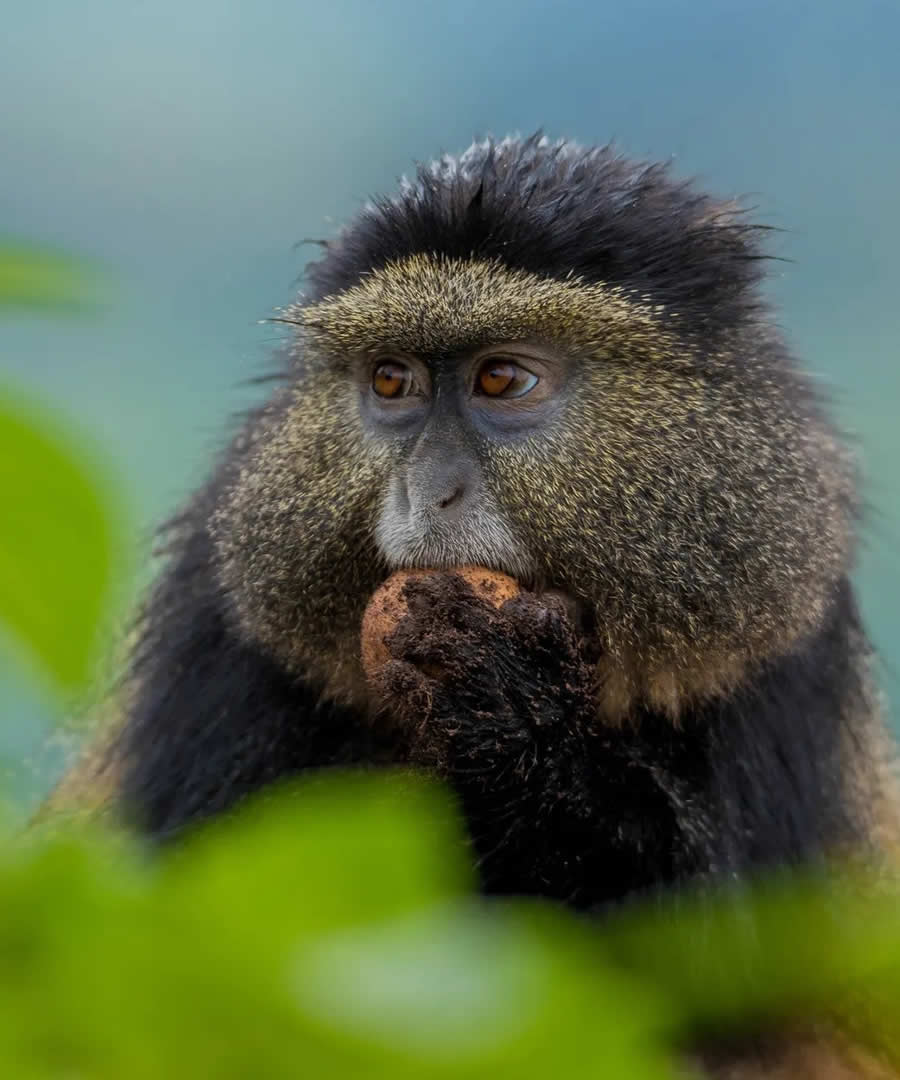
Rwanda's newest park — a restored highland rainforest sheltering chimpanzees, golden monkeys and a powerful story of ecological recovery.
Explore →